Ask a hundred learners how they build vocabulary and roughly ninety will describe some version of the same system: encounter a word, write it in a notebook with a translation, intend to review it, and never look at the notebook again. The words that survive this process are the ones that would have survived anyway.
The good news is that vocabulary is the area of language learning where the research is clearest and the techniques most reliable. This article covers how many words you actually need, why lists fail, how spacing works, why collocation matters more than definition, and a weekly system that produces roughly twenty usable words a week in fifteen minutes a day.
How many words do you actually need?
Vocabulary size is usually measured in word families — decide, decides, decided, decision, undecided is one family, not five. The numbers below are the standard reference points from corpus research.
| Word families | What it gives you | Roughly |
|---|---|---|
| 1,000 | ~75% of everyday spoken text. Basic survival. | A1–A2 |
| 2,000 | ~85% of speech. Everyday conversation becomes possible. | B1 |
| 4,000 | ~93% of general text. Comfortable independent use. | B2 |
| 8,000 | ~98% of written text — the threshold for reading novels and newspapers without a dictionary. | C1 |
| 15,000+ | Approaching an educated native-speaker range. | C2 |
Two things follow. First, the gap between B1 and B2 is about two thousand families — at twenty a week that is under two years, which is encouraging. Second, the 98% figure matters enormously: below it, reading for pleasure is hard work, and above it, reading itself starts teaching you vocabulary automatically. Getting past that threshold is the highest-leverage vocabulary goal there is.
Start with frequency
The most common 2,000 word families cover the large majority of everyday English. If you are below B2, studying a general-service frequency list will do more for you than any specialised vocabulary, however interesting the specialised words are.
Why word lists fail
Recognition is not production
Knowing a word is not binary. There is receptive knowledge (you understand it when you meet it) and productive knowledge (you can retrieve and use it correctly). A translation list builds the first and barely touches the second, which is why learners with large "vocabularies" often speak in a small circle of words.
Knowing a word means knowing eight things
Applied linguists list roughly eight kinds of knowledge attached to a single word:
- Form — how it sounds and how it is spelled.
- Meaning — its core sense, and which senses it does not have.
- Grammar — its part of speech and what structures follow it.
- Collocation — which words it habitually appears with.
- Register — formal, neutral, informal, technical.
- Connotation — positive, negative or neutral colouring.
- Frequency — whether it is common enough to be worth using.
- Constraints — regional, dated, or specific to a field.
A list of the form "ubiquitous = everywhere" gives you one and a half of these. That is why the word later appears in your writing as "the ubiquitous of smartphones", which is not a mistake of meaning but of every other kind of knowledge.
Words learned out of context are stored out of context
Memory is cue-dependent. A word learned in a list is cued by the list; a word learned in a sentence you cared about is cued by meaning, situation and grammar. The second is retrievable in conversation; the first is retrievable during a vocabulary test.
How spaced repetition actually works
Memory decays predictably. Review just before you would have forgotten, and the memory is not merely refreshed — the interval before the next forgetting gets longer. Repeat this, and the intervals stretch from days to weeks to months. That is the whole mechanism.
A workable schedule
If you are not using software, this manual schedule is close enough to optimal:
- Review 1 — same day, a few hours after the encounter
- Review 2 — next day
- Review 3 — three days later
- Review 4 — one week later
- Review 5 — two weeks later
- Review 6 — one month later
- Review 7 — three months later
Seven touches, spread over about four months, will hold a word more or less permanently. Twenty touches in one evening will hold it until Thursday.
Retrieval, not recognition
This is the part people get wrong. Reading over your notes is not review — it produces a strong feeling of familiarity and almost no learning. You must retrieve: cover the answer, attempt it, and only then check. The mild discomfort of struggling to recall is the mechanism working; if review feels easy, it is probably not doing anything.
Make the card produce, not translate
A weak card: ubiquitous → everywhere. A strong card: "Smartphones have become ___ in almost every country" (u______). The second forces retrieval in a grammatical context, which is exactly the skill you want back later.
Collocation: the thing that makes you sound fluent
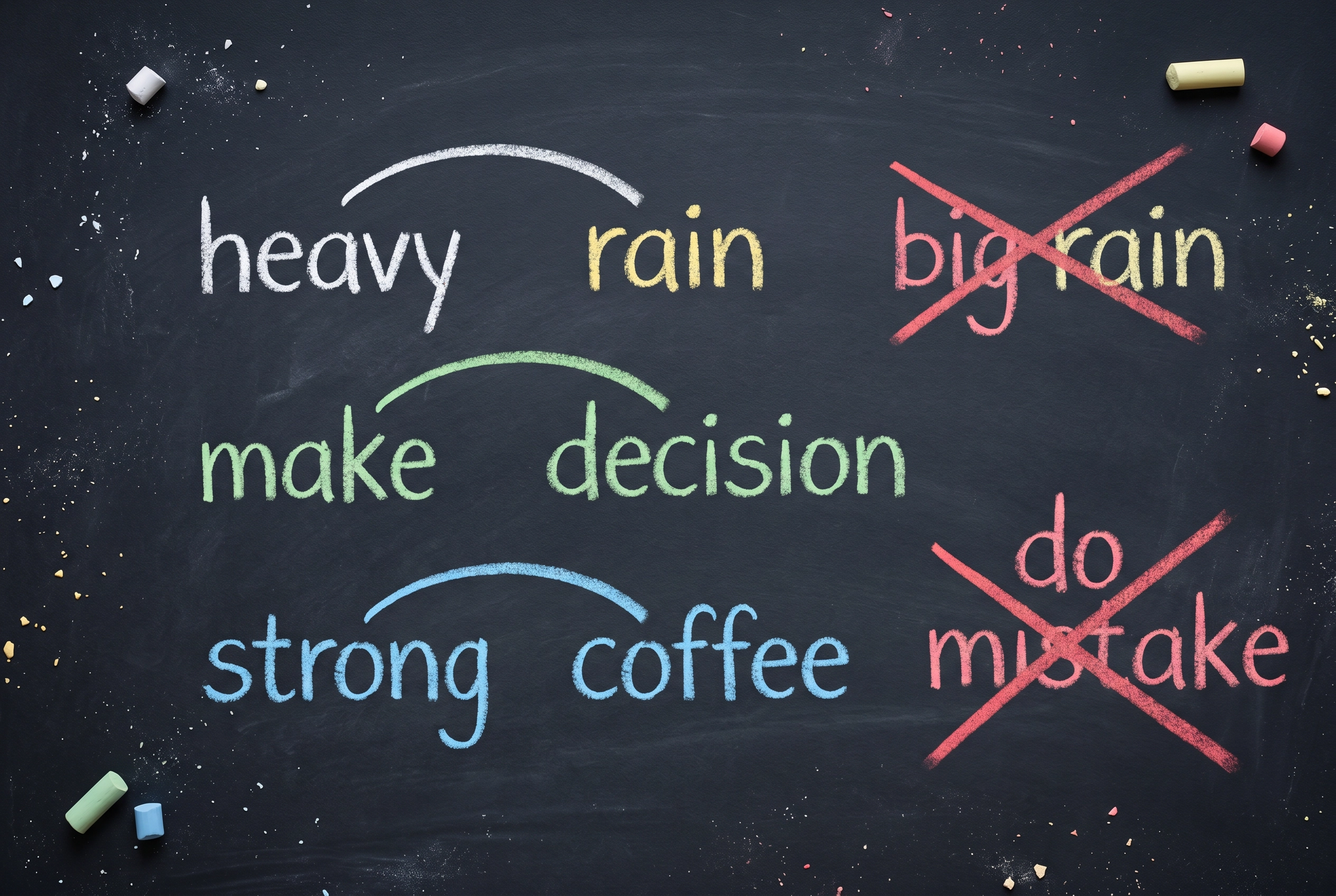
Collocation is the tendency of words to keep particular company. English says heavy rain, not strong rain; strong coffee, not heavy coffee; you make a decision but take a break. None of it is logical, all of it is learnable, and it is the clearest single marker separating advanced learners from intermediate ones.
Types worth collecting
| Pattern | Examples |
|---|---|
| adjective + noun | a pressing issue · a steep learning curve · a common misconception |
| verb + noun | raise an objection · meet a deadline · draw a distinction |
| adverb + adjective | bitterly disappointed · widely regarded · deeply concerned |
| verb + preposition | depend on · consist of · result in · account for |
| fixed expression | to be honest · as far as I know · at short notice |
Learn the phrase, store the phrase
Instead of recording issue, record a pressing issue that needs addressing. The extra words cost you nothing to learn — chunks are stored as single units — and they arrive complete when you need them, with the grammar already attached. This is the closest thing to a shortcut that vocabulary learning has.
The thesaurus trap
A thesaurus lists words with overlapping meanings, not interchangeable words. Slim, slender, skinny and gaunt all mean thin and are not swappable. If you take a word from a thesaurus, check an example sentence in a dictionary before you use it.
Where to get words worth learning
The best source of vocabulary is material you would read or watch anyway, at a level where you understand most of it. Two rules:
The 98% rule for reading
If you know 98% of the words on a page — about one unknown word in fifty — you can infer the rest from context and read comfortably for pleasure. Below 95%, comprehension collapses and reading becomes decoding. If you are stopping every line, the text is too hard, however worthy it is.
Mine narrow, not wide
Reading five articles on the same subject teaches more vocabulary than five articles on five subjects, because the same specialised words recur and you get spaced repetition for free. Pick a topic you care about and stay with it for a fortnight.
Sources ranked by usefulness
- Your own life. Words you needed and could not find during a conversation. These have the highest retention rate of anything, because the gap was felt.
- Graded readers and level-appropriate journalism — designed to sit near your 98%.
- Podcasts and video with transcripts — you get pronunciation and collocation together.
- Frequency lists — efficient but dull; best used to fill gaps rather than as a main diet.
- Vocabulary apps' default decks — convenient, but the words are not yours and retention shows it.
A weekly system: twenty words in fifteen minutes a day
Monday to Wednesday — collect
Carry one capture place: a notes app, a card, anything single. Write the whole sentence where you met the word, not the word alone. Aim for six or seven a day; you will discard some. Do not stop to study — collection and study are separate activities and mixing them ruins both.
Wednesday evening — select and build
You will have twenty to thirty candidates. Cut to twenty using three tests:
- Frequency: will I meet this again this month?
- Need: did I actually want this word for something I was trying to say?
- Gap: do I already have a word that does this job perfectly well?
For each survivor write a card with four things: the target chunk (not the bare word), a gapped example sentence, one collocation, and a note on register. Four fields, ninety seconds each.
Thursday to Sunday — retrieve
Ten minutes daily of active recall on this week's twenty plus whatever is due from previous weeks. Cover, attempt, check. Anything you get wrong twice goes back to the start of the schedule.
Every day — produce
Five minutes: write three sentences or speak for one minute using this week's words. This is the step almost everyone skips and it is the step that converts receptive knowledge into productive knowledge. A word you have never said out loud is not yet yours.
The five-word rule for lessons
Bring five words from your list to every lesson and force them into the conversation, however awkwardly. Used once under mild pressure, with feedback, a word moves into production faster than after ten silent reviews.
Six mistakes that waste vocabulary time
- Learning too many at once. Fifty words a week feels ambitious and produces worse twelve-month retention than twenty, because none of them get enough retrieval.
- Recording single words. No grammar, no collocation, no register. Record chunks.
- Reviewing by reading. Familiarity is not memory. Cover the answer.
- Chasing rare words. An impressive word used slightly wrongly damages you more than a common word used precisely. Precision reads as competence; rarity reads as effort.
- Never using them. The single biggest cause of the passive-vocabulary problem.
- Abandoning the schedule after two weeks. The intervals that matter most — one month, three months — are the ones people never reach.
How to know it is working
Vocabulary growth is slow and almost invisible from inside, which is why people quit. Three measurements make it visible:
- The unknown-word count. Once a month, read a page of the same publication and count words you do not know. Watch the number fall.
- The production test. Write for ten minutes on a fixed topic, once a month, same topic each time. Compare the range of the last version with the first.
- The retrieval failure log. Note every time you reach for a word and cannot find it. This is both a measure and your next week's word list — which makes it the most useful habit on this page.
Questions people ask about this
Around twenty word families is the sustainable maximum for most learners, and it produces better one-year retention than trying to learn fifty. The limit is not how many you can meet but how many you can review and actually use.
Yes, and the effect is large. Reviewing at increasing intervals — same day, next day, three days, a week, a fortnight, a month — holds material far longer than the same total time spent in one session, because each successful retrieval lengthens the forgetting curve.
A translation is fine as a memory hook, but it should not be the whole card. Add a gapped example sentence, one collocation and a note on register, so the card forces production in context rather than a word-for-word swap.
Because recognition and production are stored and retrieved differently. Receptive knowledge grows from reading and listening; productive knowledge grows only from attempting to use the word, ideally under mild pressure and with feedback.
They handle the scheduling well, which is the tedious part. Their weakness is the default decks: words someone else selected have much lower retention than words you collected because you needed them. Use the app, but fill it with your own material.
Around 8,000 word families, which gives roughly 98% coverage of written text — about one unknown word in fifty. Below that, reading for pleasure becomes decoding, and the vocabulary gains from reading drop off sharply.
The short version
Collect chunks rather than words, from material you would read anyway; cut to twenty a week using frequency, need and gap; review by retrieval at expanding intervals; and force each word into speech or writing at least once. Twenty usable words a week beats fifty forgotten ones.