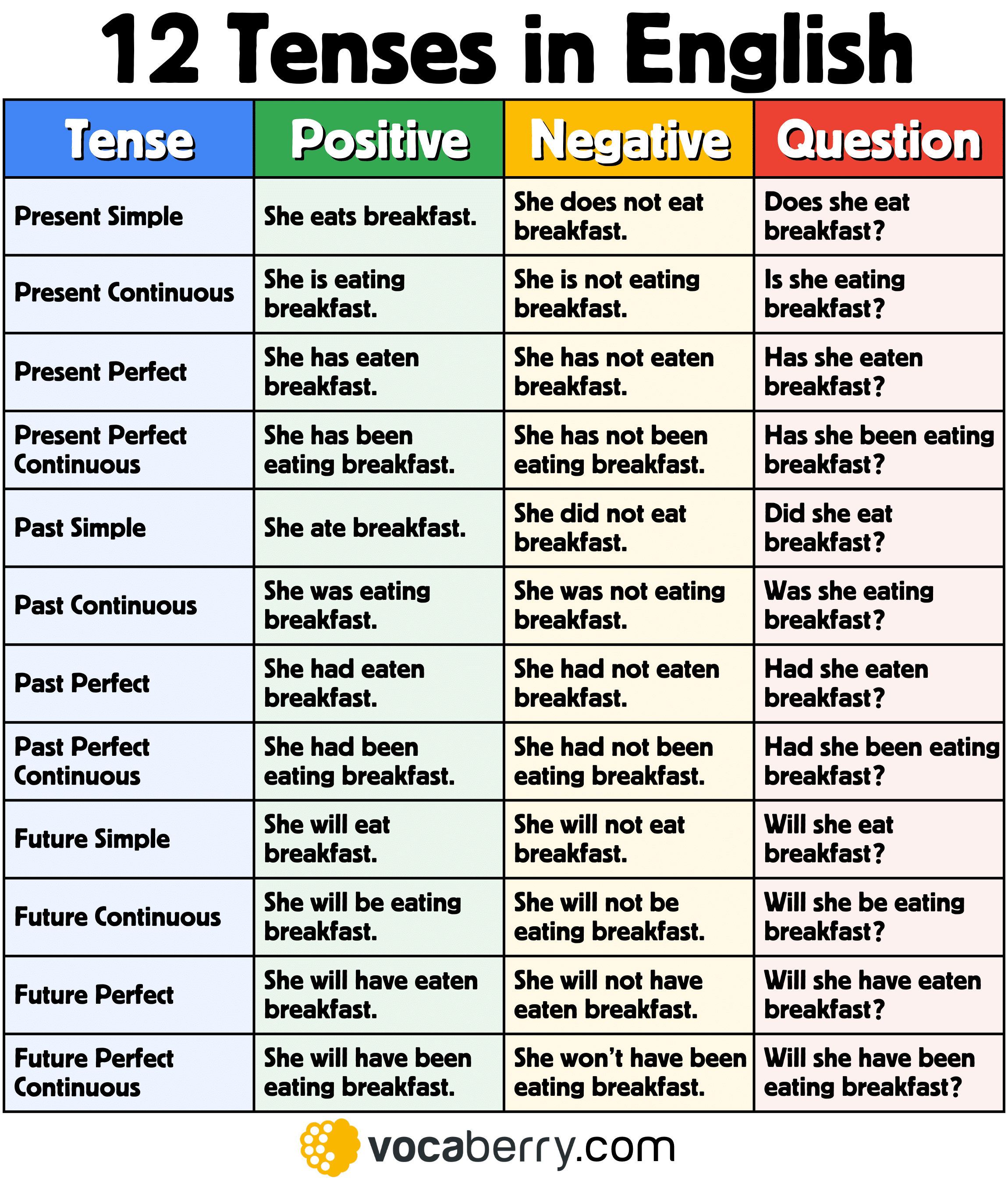
"There are twelve tenses in English" is the sentence that makes learners despair, because it sounds like twelve unrelated things to memorise. It is not. There are three times and four aspects, and every tense is a combination of one of each. Three times four is twelve. Once you can see the grid, the system stops being a list and becomes a shape.
This article builds that grid, explains what each aspect actually means rather than when a textbook says to use it, works through the six confusions that account for most errors, and finishes with practice you can do without a partner.
The grid: three times, four aspects
Time answers "when": past, present, future.
Aspect answers "how am I viewing it": as a whole, as ongoing, as connected to a later point,
or as ongoing up to a later point.
| Simple | Continuous | Perfect | Perfect continuous | |
|---|---|---|---|---|
| Past | I worked | I was working | I had worked | I had been working |
| Present | I work | I am working | I have worked | I have been working |
| Future | I will work | I will be working | I will have worked | I will have been working |
What each aspect means, in one line
- Simple — the event as a complete unit, or as a general fact. No interest in its internal shape.
- Continuous — the event as unfinished, in progress, temporary. You are standing inside it.
- Perfect — the event is complete before a reference point, and it matters at that point.
- Perfect continuous — the event has been in progress up to a reference point, and the duration matters.
The single most useful reframe
Perfect is not a time. It is a relationship between two points: something before, something after, and a connection between them. Once you stop asking "is this past?" and start asking "before what?", the perfect tenses become straightforward.
The present tenses
Present simple — I work
Uses: permanent situations, habits and routines, general truths, timetables, and commentary. It is the tense of things that are simply the case.
- She works in Lisbon. (permanent)
- I check my email twice a day. (habit)
- Water boils at 100 degrees. (general truth)
- The train leaves at 6:40. (timetable — note this is future in meaning)
Present continuous — I am working
Uses: happening now, happening around now, temporary situations, changing situations, and arranged future plans. Also, with always, for irritation.
- I'm writing an article. (now)
- I'm reading a good book at the moment. (around now — not literally this second)
- She's staying with her sister until the flat is ready. (temporary)
- English is becoming more informal. (changing)
- We're meeting the client on Tuesday. (arranged future)
- He's always losing his keys. (irritation)
Present perfect — I have worked
The tense that gives learners the most trouble, largely because many languages use a past tense where English uses this one. Present perfect connects a past event to now. It is used for experience without a specific time, for a result that still matters, and for unfinished time periods.
- I've been to Japan twice. (experience, time unspecified)
- I've lost my passport. (result: I still don't have it)
- She's finished the report. (it is ready now)
- I've written three emails today. (today is not over)
Present perfect continuous — I have been working
Duration up to now, with the activity itself in focus, and often with visible present evidence.
- I've been studying for six hours. (duration matters)
- It's been raining — the roads are wet. (present evidence)
- She's been asking about you. (repeated recent activity)
The past tenses
Past simple — I worked
A finished action at a finished time. If the time is stated, implied or obvious, English uses past simple — this is the rule that overrides most others.
- I worked there for three years. (and I no longer do)
- She called yesterday.
- Did you see that? (a moment ago, but finished)
Past continuous — I was working
Background, interrupted actions, and two simultaneous activities. It sets the stage; past simple provides the events.
- I was working when the power went out. (background + interruption)
- While she was cooking, he was writing.
- It was raining, and nobody had brought an umbrella. (scene-setting)
Past perfect — I had worked
Earlier past: an event completed before another past event. Use it only when the sequence genuinely needs marking — English does not require it when before or after already makes the order clear.
- By the time I arrived, she had left.
- He couldn't get in because he had forgotten his badge.
- I realised I had met her before.
Past perfect continuous — I had been working
Duration up to a point in the past.
- She had been waiting for an hour when the email finally arrived.
- They were tired because they had been travelling all day.
Do not over-use past perfect
A frequent over-correction: narrating an entire story in past perfect. Establish the earlier point once, then switch to past simple. "By then she had left the company. She moved to Berlin, found a job in publishing and never came back." Only the first verb needs the perfect.
The four futures — and the two that are not tenses
English has no future tense in the way it has past and present forms. It has several ways of talking about the future, and choosing between them is about the speaker's attitude, not about the timing.
| Form | Meaning | Example |
|---|---|---|
| will | Decision made now, prediction, offer, promise | I'll help you with that. |
| going to | Prior intention; prediction from present evidence | I'm going to apply for the role. / Look at those clouds — it's going to pour. |
| present continuous | A fixed arrangement, usually with another person | I'm meeting Sara at four. |
| present simple | Timetables and schedules | The conference starts on the 12th. |
| future continuous | In progress at a future moment; also a neutral, non-imposing enquiry | This time tomorrow I'll be flying. / Will you be using the room? |
| future perfect | Completed before a future point | By June we'll have finished the migration. |
| future perfect continuous | Duration up to a future point | By next month I'll have been working here for a decade. |
Will versus going to, settled
The distinction is about when the decision was made, not about certainty.
- Phone rings. "I'll get it." (decided at this moment → will)
- "I'm going to redecorate the kitchen." (decided earlier → going to)
- "It'll probably rain." (prediction from opinion → will)
- "It's going to rain." (prediction from evidence you can see → going to)
Six confusions that cause most errors
1. Present perfect vs past simple
The deciding question is whether the time period is finished.
- ✗ I have seen him yesterday. → ✓ I saw him yesterday. (yesterday is finished)
- ✓ I have seen him today. (today is not finished)
- ✓ Have you ever been to Rome? — ✓ Yes, I went in 2019. (experience, then specific time)
A note for American English: past simple is increasingly acceptable where British English requires present perfect ("Did you eat yet?"). In an exam, use the British pattern.
2. State verbs in the continuous
Verbs of thinking, feeling, possessing and perceiving usually resist the continuous: know, believe, own, belong, contain, seem, prefer, understand.
- ✗ I am knowing the answer. → ✓ I know the answer.
- But: ✓ I'm thinking about it. (deliberate mental activity, not a state)
- And: ✓ I'm loving this. (informal, deliberately temporary)
3. Since vs for
Since takes a starting point; for takes a duration. Both attach to perfect forms.
- ✓ I've lived here since 2018. / ✓ I've lived here for eight years.
- ✗ I live here since 2018. (needs a perfect form)
4. Perfect vs perfect continuous
Perfect emphasises the result; perfect continuous emphasises the activity and its duration.
- I've read three chapters. (result: three chapters done)
- I've been reading all afternoon. (activity and duration; may be unfinished)
5. Will in time clauses
After when, if, as soon as, before, after, until, English uses a present form for future meaning.
- ✗ I'll call you when I will arrive. → ✓ I'll call you when I arrive.
- ✓ As soon as she has finished, we'll start.
6. Used to, would and the past habitual
- Used to — past states and habits: "I used to live in Delhi." Works for both.
- Would — repeated past actions only, usually in narrative: "Every summer we'd drive to the coast." Not with states: ✗ "I would live in Delhi."
- Be used to — a different structure entirely, meaning "accustomed to", followed by a noun or -ing: "I'm used to getting up early."
How tenses work together in a real paragraph
Isolated sentences hide the real skill, which is moving between tenses coherently. Read this and watch the shifts:
I have been teaching English since 2013 (duration up to now). When I started, I had a class of thirty-two children and no idea what I was doing (finished past, background). I had assumed that a good lesson plan was enough (earlier past belief). By the end of that first year I had learned otherwise (completed before a past point). These days I teach one student at a time (present habit), and next month I will have been doing that for a decade (duration up to a future point).
Six tenses, one paragraph, and none of them optional — each carries information the others cannot. That is what the system is for: it is not decoration, it is how English encodes the shape of time.
Practice that works without a partner
The three-version drill
Take one situation and describe it in three tenses. "The project": We are redesigning the site. We have redesigned the homepage already. By December we will have finished. Doing this aloud, daily, builds the selection reflex far faster than gap-fill exercises, which train recognition rather than choice.
The narration drill
Describe your day yesterday in ninety seconds. Then describe it again, adding one past perfect and one past continuous. Then again, in the present, as if it were a routine. Same content, three tense systems.
The error-log drill
Record two minutes of speech, transcribe it, and mark only the tense errors. Almost everyone finds a single recurring pattern — usually present perfect, sometimes articles pretending to be a tense problem. Drill that one pattern for a fortnight and the error rate drops sharply.
Why gap-fill exercises disappoint
A gap-fill tells you which tense goes in a slot someone else designed. Real speech requires you to choose the slot as well as the filler. Use gap-fills to check understanding, then move immediately to production.
Questions people ask about this
Strictly, English has two grammatical tenses — present and past — and everything else is built from aspect and modal verbs. The “twelve tenses” model is a teaching convenience: three times combined with four aspects. It is a useful map even though it is not how linguists describe the system.
Use present perfect when the time period is unfinished (“today”, “this week”), when the time is unspecified and the experience is the point, or when a past event has a result that matters now. Use past simple whenever the time is finished, stated or obvious.
The perfect emphasises the completed result; the perfect continuous emphasises the ongoing activity and its duration. “I’ve written three emails” reports output. “I’ve been writing emails all morning” reports how you spent the time, and the task may not be finished.
Verbs describing states rather than actions — know, believe, own, seem, prefer — normally resist the continuous, because the continuous marks something as temporary and in progress. Some of these verbs do take the continuous when they describe deliberate activity, as in “I’m thinking about it”.
No. “Will” is a modal verb expressing prediction, willingness, offers and decisions made at the moment of speaking. English expresses the future in at least seven ways, and the choice signals your attitude to the event rather than its distance in time.
Understanding the grid takes an afternoon. Producing the right tense automatically under pressure takes most learners several months of spoken practice, because tense choice has to become a reflex rather than a calculation.
The short version
There are not twelve unrelated tenses — there are three times and four aspects. Simple views an event as a whole, continuous views it from inside, perfect links it to a later point, and perfect continuous stretches it up to that point. Learn the grid, then drill the one pattern your error log keeps showing you.